Finding the best mirrorless camera for travel is not an easy task due to the vast offer these days.
There are many factors we need to understand to know which is the best mirrorless camera for our travel needs.
For us, the best mirrorless cameras for travel should have great image quality, be light and not too bulky, weather-sealed and support 4K video.
On this list, we are going to help you to understand your needs better and provide you with the top mirrorless cameras for any travel photographer.
Let’s dive in to find the best travel camera for you!
This page may contain affiliate links. Click here to read our disclosure
Best mirrorless cameras for travel: Editor’s Choice
Our pick is the Fujifilm X-T5. We have carried its predecessor, the X-T4, for years; the X-T5 is its direct replacement, and it is the one we would buy today.
PROS
- 40.2 MP APS-C sensor with 6.2K video.
- Weather-sealed at 56 points, down to -10°C.
- Seven stops of in-body stabilisation — the complaint we had about the X-T4.
- 580 shots per charge.
CONS
- The heaviest APS-C body here at 557 g.
- 40 MP files fill cards and hard drives quickly on a long trip.
Mirrorless cameras definition
A mirrorless camera is a type of camera that works without a reflex mirror. The light passes through the lens directly to the digital sensor, which then displays your image on the camera’s LCD screen, allowing you to adjust settings and preview your image before its shot.
A mirrorless camera is similar in many ways to a larger DSLR without the mirror.
In a mirrorless camera, the imaging sensor is exposed to light directly when the shutter is open. This allows you to have a digital preview of your image through an electronic viewfinder and/or a rear liquid crystal display (LCD) screen. This allows you to see on the screen exactly what the image you capture will look like.
A mirrorless camera is one that doesn’t require a reflex mirror, a key component of DSLR cameras.
The mirror in a DSLR reflects the light up to the optical viewfinder. In a mirrorless camera, there is no optical viewfinder. Instead, the imaging sensor is exposed to light at all times. This gives you a digital preview of your image either on the rear LCD screen or an electronic viewfinder (EVF).
The good thing about mirrorless cameras is that they offer about the same features as a DSLR but in a smaller format. They provide great image quality and the ability to change lenses.
As a result, it makes a perfect travel camera since they take less space and still almost all the benefits that a DSLR would offer.
Is not the smaller format though, since you can still opt for compact cameras or even smartphones, although the results won’t be as good.
Price-wise, a mirrorless camera can also be very expensive. Like everything, the price will depend on many different factors.
In my case, I would go for mirrorless cameras for travel photography because of the quality they deliver in a still manageable format to carry.
Our pick is the Fujifilm X-T5: weather-sealed, seven stops of stabilisation and 40 MP in a body you can carry all day. The nine we would buy, in the order we rank them:
- Fujifilm X-T5
- OM System OM-5 Mark II
- OM System OM-3
- Canon EOS R50
- Sony a6700
- Canon EOS R8
- Nikon Z5II
- Nikon Z6III
- Sony A7 V
Understanding the mirrorless: camera sensor sizes
Sensors inside a digital camera is an important component.
An image sensor is an electronic device that translates an optical image to an electrical signal. The sensor receives the light coming in via the lens into the camera and then turns that into an image. The individual pixels on the sensor are light-sensitive elements which record the light that hits them. This is a very simplified version of how an image sensor works
Sensors come in a variety of sizes, from the tiny image sensors inside a smartphone, through to the larger sensors inside professional-level mirrorless and DSLR cameras.
Generally, the larger the sensor, the better the camera will perform in low-light, as it is able to capture more of the available light. A larger sensor also allows for greater depth of field effects. However, a larger sensor also requires a larger camera.
In mirrorless cameras, there are three main sensor sizes. These are, from smallest to largest: Micro Four Thirds, APS-C, and full frame sensor.
Are mirrorless the best cameras for travel photography?
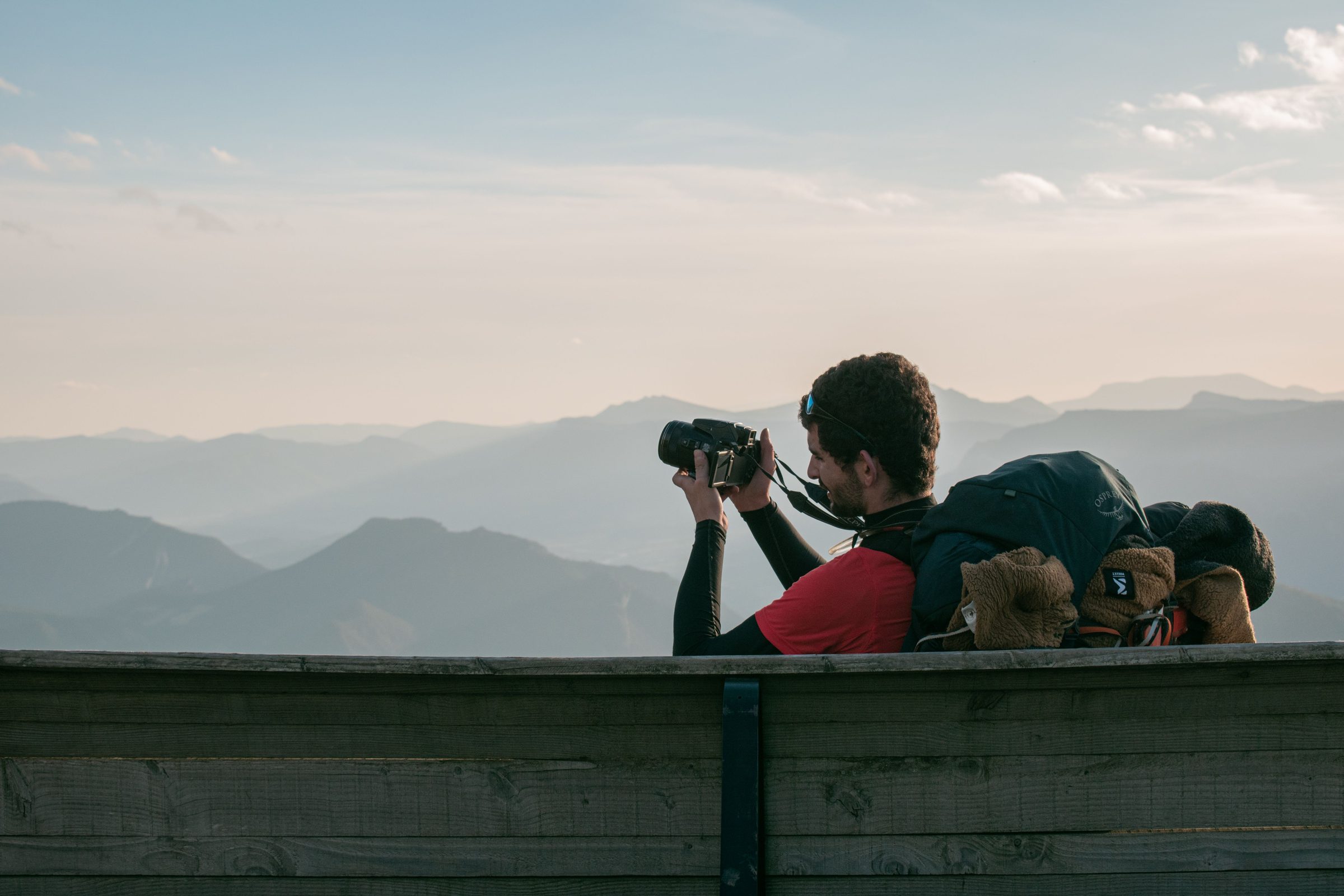
The good thing about mirrorless cameras is that they offer about the same features as a DSLR but in a smaller format. They provide great image quality and the ability to change lenses. It does not mean a mirrorless is the best camera for travel. But it makes a perfect travel camera since they take less space and still almost all the benefits that a DSLR would offer.
Is not the smaller format though, since you can still opt for compact cameras or even smartphones, although the results won’t be as good. Price-wise, a mirrorless camera can also be very expensive. Like everything, the price will depend on many different factors.
In my case, I would go for mirrorless cameras for travel photography because of the quality they deliver in a still manageable format to carry.
Advantages and disadvantages of different types of cameras.
Since we are talking about cameras, an image is worth a thousand words. So we want to use this useful infographic we created with the main advantages and disadvantages of mirrorless cameras.

Some of the images used for the infographic are from freepik and rawpixel
Related: 10 Tips to Quickly Improve your Aerial Drone Photography
Free
Free PDF: The A-Z of World Budget Destinations
32 pages. Download it now, free.
Instant download. No spam.
Review of the best mirrorless cameras for travel
This list was rebuilt from scratch in September 2026, because the previous one had stopped being useful. Canon closed the EF-M mount, so the EOS M200 we recommended has no future in lenses. Olympus is now OM System. The Sony A6500 and A6100 are discontinued, the X-T4 became the X-T5, the Z6 is now on its third generation, and the A7 III has been replaced twice over.
Every weight below is the manufacturer’s own figure including battery and memory card, so the numbers are comparable with each other, and every one is linked to the page it came from. Where a manufacturer does not publish a weather-sealing claim we say so rather than guessing — the difference between a stated IP rating and a reviewer’s impression matters the first time you get caught in rain.
We have deliberately left prices out. A price we checked today would be wrong by the time you read this, and a wrong price in a buying guide is worse than no price at all.
Fujifilm X-T5
Best Overall
| Weight (with battery) | Weather sealing | Max video |
|---|---|---|
| Approx 557g | Yes | 6.2K / 4K |
This is the camera we would buy again. The X-T5 is the direct replacement for the X-T4 we shot this site with, and it fixed the thing we complained about: it is smaller and lighter than the camera it replaced, not bigger.
A 40.2 MP APS-C sensor and seven stops of in-body stabilisation, both to CIPA standard. Fujifilm quotes 56 weather-sealed points “for high levels of dust and moisture resistance” and operation down to -10°C, and rates the battery at 580 frames in normal mode — a full day of walking without thinking about it.
The catch is the files. Forty megapixels fills cards and laptops fast, and on a long trip that is a real cost. It is also the heaviest APS-C body here at 557 g with battery and card.
Source: Fujifilm specifications · Fujifilm on the sealing.
OM System OM-5 Mark II
Best for bad weather
| Weight (with battery) | Weather sealing | Max video |
|---|---|---|
| Approx 418g | Yes (IP53) | 4K / C4K 30p |
If you shoot in rain, dust and cold, nothing here matches the weight-to-protection ratio. OM System certifies the OM-5 Mark II to IP53 — weather-sealed, freezeproof to -10°C — in a body of 418 g with battery and card.
That is a rating, not a marketing adjective, and it is the reason this is the one we would hand to someone going trekking. Stabilisation is quoted at up to 7.5 stops with Sync IS lenses, which buys you handheld shots at shutter speeds that should not work.
Two honest limits: the sensor is 20.4 MP Micro Four Thirds, so you have less room to crop than the APS-C bodies here, and OM System rates it at 310 shots per charge. Carry a spare battery.
Source: OM System.
OM System OM-3
Best Micro Four Thirds
| Weight (with battery) | Weather sealing | Max video |
|---|---|---|
| Approx 496g | Yes (IP53) | C4K / 4K 60p |
The OM-3 puts the same IP53 sealing — splashproof, dustproof, freezeproof — around a 20.4 MP sensor, with 4K at 60p rather than the OM-5 Mark II’s 30p ceiling, and 590 shots per charge in standard mode.
At 496 g it is still lighter than every full-frame body on this list, and the sealing means you are not babying it. This is the Micro Four Thirds camera to buy if you shoot video as well as stills.
The argument against it is price against sensor size: you are paying roughly what a 40 MP APS-C camera costs for a 20 MP sensor. Whether that is worth it depends on how much the sealing and the smaller lenses matter to you.
Source: OM System.
Canon EOS R50
Best entry-level
| Weight (with battery) | Weather sealing | Max video |
|---|---|---|
| Approx 375g | Not stated | 4K 30p |
The lightest camera on this list at 375 g, and the one we would point a beginner at. A 24.2 MP APS-C sensor, 4K 30p oversampled from 6K, and Canon’s RF-S lenses behind it.
A note on why the old version of this guide is gone: we used to recommend the Canon EOS M200 here. Canon has discontinued the EOS M line and the EF-M mount, so that camera is a dead end for lenses. The R50 is where that money should go now.
The compromises are real. Canon’s specification lists no in-body stabilisation, video tops out at 4K30, and Canon makes no weather-sealing claim for this body. It is a camera for good conditions.
Source: Canon specifications.
Sony a6700
Best APS-C for video
| Weight (with battery) | Weather sealing | Max video |
|---|---|---|
| Approx 493g | Not in Sony’s specs | 4K 120p |
This is what replaced the A6500 and A6100 we used to list here, and it is a much better camera than either: a 26 MP APS-C sensor, 4K at up to 120p, in a 493 g body with battery and card.
On weather sealing we are going to be careful. Sony’s published specification for this camera does not state a dust or moisture rating — the “anti-dust” entry on the spec sheet refers to a coating that keeps the sensor clean, which is a different thing. Plenty of reviews call it splash resistant; Sony’s own sheet does not, so we are not going to claim it for them.
The other downside is a single SD slot, which is a genuine risk on a trip you cannot repeat.
Source: Sony Help Guide specifications.
Canon EOS R8
Lightest full frame
| Weight (with battery) | Weather sealing | Max video |
|---|---|---|
| Approx 461g | Yes (dust and drip) | 4K 60p |
A full-frame 24.2 MP sensor in a 461 g body, with 4K 60p oversampled from 6K. That weight is the whole point: the R8 is lighter than the Micro Four Thirds OM-3 on this list, which has a sensor a quarter of the size. If the received wisdom is that full frame means heavy, this is the camera that breaks it.
Canon describes the chassis as dust- and water-resistant magnesium alloy. What it leaves out is stabilisation: the specification lists in-body IS as “No”, so you are relying on stabilised lenses.
Canon has since announced an EOS R8 Mark II which adds a 5-axis in-body stabiliser and dust-and-drip sealing across the battery compartment, card slot and controls. If you are buying in the next few weeks, check whether it has reached shops before committing to the original.
Source: Canon specifications.
Nikon Z5II
Best value full frame
| Weight (with battery) | Weather sealing | Max video |
|---|---|---|
| Approx 700g | Yes | 4K 60p |
The sensible full-frame choice. A 24.5 MP sensor in a magnesium-alloy body that Nikon describes as “sealed against dust and moisture”, at 700 g with battery and card.
The detail that matters on the road is the card slots: two of them, both UHS-II SD. You are not buying expensive CFexpress cards, and you can write to a backup card as you shoot. After losing a card once, we would pay for that alone.
It is 700 g, which you feel by the end of a day, and video stops at 4K60 with no 6K RAW. It is the camera for someone who mostly takes photographs.
Source: Nikon specifications · Nikon on the sealing.
Nikon Z6III
Best full-frame hybrid
| Weight (with battery) | Weather sealing | Max video |
|---|---|---|
| Approx 760g | Yes | 6K RAW / 4K 120p |
The replacement for the Z6 we used to list, two generations on. A 24.5 MP sensor, 6K RAW and 4K up to 120p, and a magnesium-alloy and Sereebo body Nikon says has “the same level of dust- and drip-resistance as our professional Z8”, rated to operate down to -10°C.
If you shoot video seriously and want full frame, this is the one here. It is also the heaviest at 760 g with battery and card, and internal RAW recording needs CFexpress Type B cards, which is a real ongoing cost.
One thing to check before buying: Nikon has an open service advisory covering some Z6III and Z5II units with parts that do not meet its standards, with free repair even out of warranty. It is worth running a serial number past it.
Source: Nikon specifications · Nikon on the sealing.
Sony A7 V
Most resolution for the weight
| Weight (with battery) | Weather sealing | Max video |
|---|---|---|
| Approx 695g | Not in Sony’s specs | 4K 60p |
The successor to the A7 III that anchored the old version of this list. A 33 MP full-frame sensor at 695 g with battery and card, which is less than the 24.5 MP Nikons here carry.
As with the a6700, Sony’s published specification says nothing about dust or moisture resistance. Reviews describe this body as sealed; Sony does not, so we are not claiming it on Sony’s behalf. If weather sealing is the thing you are buying for, the Fujifilm and OM System bodies publish a figure and this one does not.
What you are buying instead is resolution and Sony’s lens catalogue, which is the largest of any mount here.
Source: Sony Help Guide specifications.
10 Quick tips to take better pictures
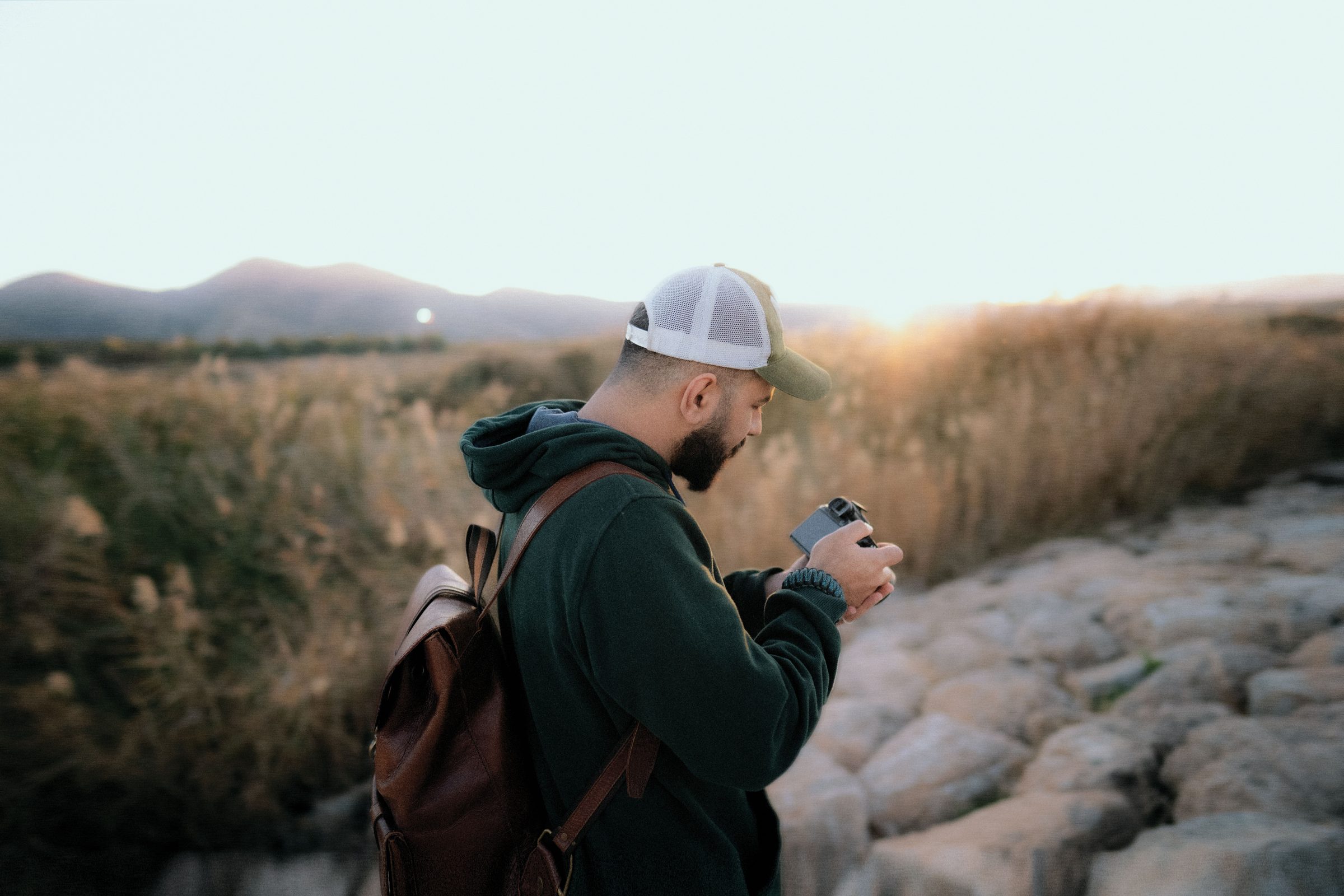
- The composition is key. Make sure you understand the rule of thirds
- Lighting is an important factor. Take advantage of the golden hours
- Get closer to the subject in your picture
- Look for elevated positions for better landscape pictures
- Use a tripod for low light conditions
- Be patient and observe the details for a different photography
- Lines in photography are beautiful
- Do some research on the place you are going to make sure you don’t miss anything worth capturing
- Shoot in manual to have full control over your photography
- Post-processing will indeed take your photography to the next level
It doesn’t matter you get the best travel camera. If you don’t practice and learn the basics, you’ll find it hard to improve.
I suggest you also check these travel photography tips for beginners.
Best Mirrorless Cameras For Travel: Conclusion
Choosing the best travel mirrorless camera is not an easy task since there are many good options. But an important thing to consider is thinking about how you want to use it short and long term. Also, you will need to take a look at the accessories and make sure it makes a good fit for your travel gear and your necessities.
Finally, make sure you read some photography books to keep learning and improving your skills. In photography, you never stop learning.
Let us know which camera is your favorite in the comments below!
Did you like the article?
PIN IT!